

How to Build a Charging as a Service Business: A Beginner’s Guide
Imagine it’s 1910, and you’re the only person in town selling gasoline, right when everyone is starting to ditch horses for those new “horseless carriages.” You’d be setting yourself up for incredible success, wouldn’t you?
Well, it’s 2026, and we are at that exact same turning point again – but this time with Electric Vehicles (EVs). People and businesses are buying electric cars and trucks faster than ever before. But they all face one major problem: “Where do I charge it reliably, especially when I’m working?”
For most businesses, buying and managing their own charging stations is a massive, complicated headache. This is where charging as a service (often called CaaS) comes in. You aren’t just selling electricity; you are selling a hassle-free solution that keeps vehicles moving. Think of it as being the “fuel subscription service” for the modern era.
What is Charging as a Service (CaaS)?
In the traditional setup, if a company wanted to offer EV charging for its employees or delivery fleet, they had to go through a complicated process. They would have to research and purchase expensive charging hardware, pay an electrician a fortune to upgrade their building’s power supply and dig up the parking lot, and then constantly worry about what to do when a charger inevitably breaks down.
With EV charging as a service, the entire model flips, making it incredibly simple for the customer. You, the service provider, own the equipment and handle everything. The customer (whether it’s a shopping mall, a delivery company with 50 vans, or a large apartment complex) simply pays you a monthly fee or a “pay-per-use” fee to use your perfectly working charging network.
For them, it’s a predictable, “worry-free” expense. For you, it creates a steady, recurring paycheck while building invaluable digital infrastructure.
Charging as a Service Market
As a businessman, you don’t just follow trends; you look at the cold, hard numbers. And right now, the charging as a service market is in an absolute explosion phase. In 2026, this global market is already valued well over $21 billion, with financial experts predicting it will rocket past $130 billion by 2034.
Why is this growth happening so fast? Several powerful forces are colliding:
Massive Government Push
Governments worldwide are offering incredible tax breaks, grants, and subsidies to anyone helping to build the green infrastructure the world desperately needs. They are practically paying you to get started.
Fleet Transition
Giant delivery companies (like Amazon, FedEx, or DHL) are rapidly switching their entire massive fleets from gas to electric. They don’t want to become experts in electrical engineering; they need massive, managed charging hubs built right now.
Widespread “Range Anxiety”
Everyday drivers are still nervous that their car will die on a long trip. They are actively seeking out reliable, fast “charging-as-a-service” spots at every hotel, restaurant, and highway rest stop they visit.
Put simply, the demand for charging is infinitely higher than the current supply. That is the single best time to enter any market.
Charging as a Service Business Model
To make real money, you can’t just install plugs randomly; you need a smart, scalable strategy. The charging as a service business model usually focuses on one of these three clear revenue paths:
- The Subscription Model: This is perfectly suited for predictable environments like apartment buildings or corporate office parks. Users pay a flat, predictable monthly fee (for example, $30 per month) for either unlimited or heavily discounted charging. This model gives you the holy grail of business: “predictable recurring revenue.” You know exactly what’s coming in every single month, allowing you to plan and grow with confidence.
- The Pay-Per-kWh Model: This is the model that’s most similar to a traditional gas station. You charge the user for precisely how much electricity (measured in kilowatt-hours, or kWh) they put into their vehicle. In 2026, standard prices typically range from $0.20 to $0.50 per kWh, depending heavily on how fast the charger is and where it’s located.
- The “Host Partnership” Model: This involves teaming up with an established location, like a popular café chain or a gym. You provide, install, and maintain the charger for free, and you share the ongoing profits with the business owner. They benefit because your chargers attract more customers who stay longer (waiting for a charge means more coffee or gym time), and you get a premium location without having to pay sky-high rent.
Step-by-Step: Building CaaS (Charging as a Service)
Building a successful charging-as-a-service company is far more strategic than just buying some expensive equipment. It requires a clear, stepwise approach:
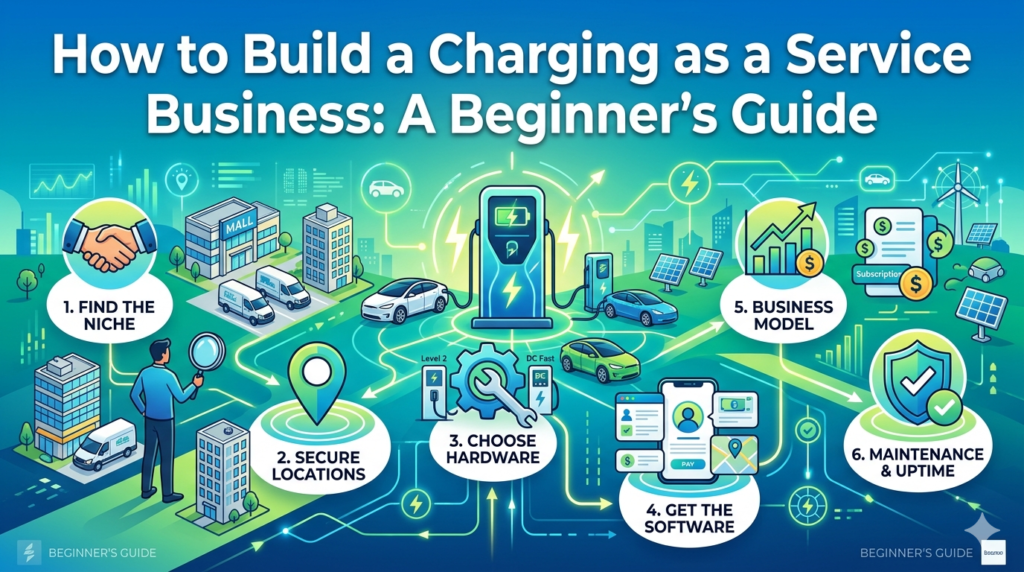
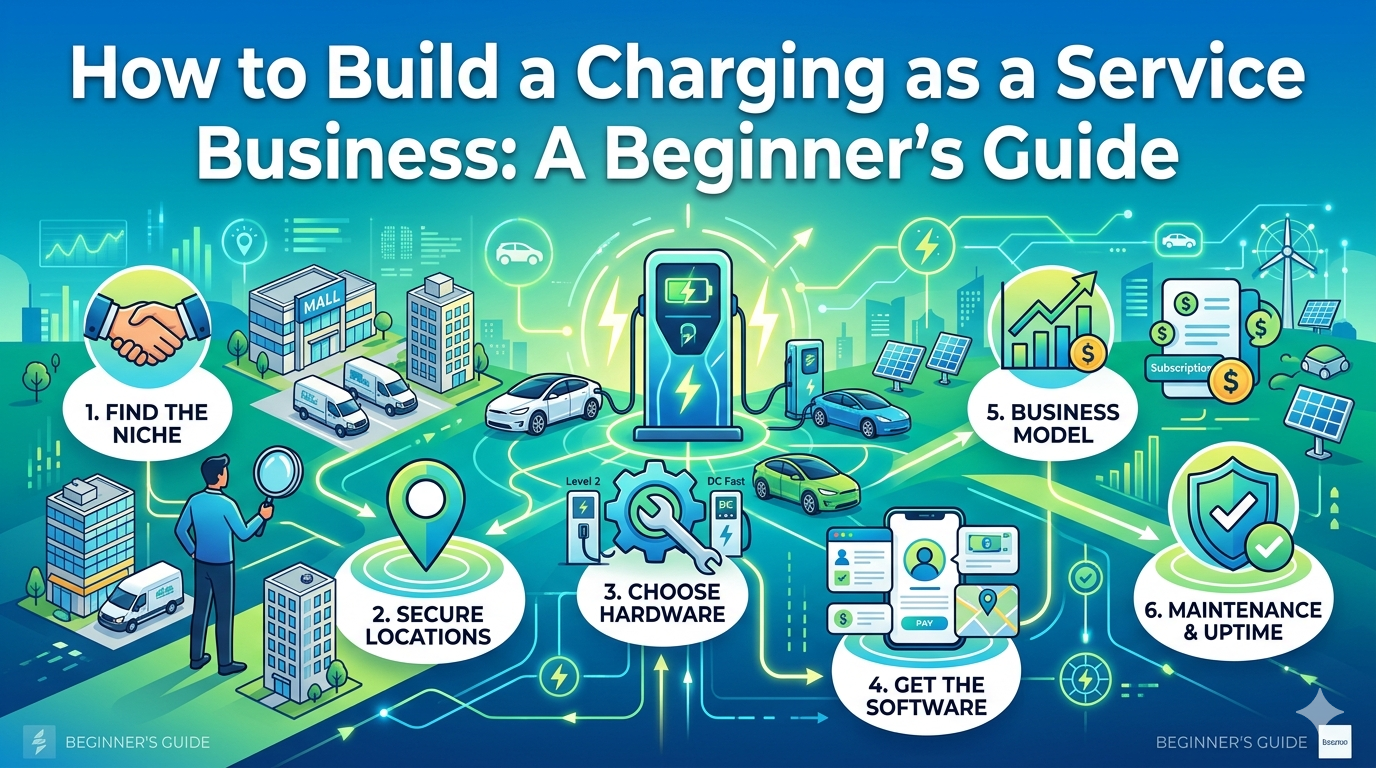
- Laser-Focus Your Niche: Don’t try to be everything to everyone immediately. Start by dominating one specific area where you can add the most value. Good examples are “Dedicated Charging for Last-Mile Delivery Fleets” or “Premium Charging for Luxury Hotels and Resorts.”
- Location, Location, Location: In this business, “digital real estate” is everything. You want locations where cars are naturally parked for at least 30 minutes (like malls, cinemas, or gyms) or places where they are guaranteed to sit idle overnight (like apartment garages).
- Choose the Right Hardware (The “Hardware Stack”): This is a critical decision. You will primarily choose between Level 2 AC chargers (slower, far cheaper to install, great for long stays) and DC Fast Chargers (incredibly fast, very expensive, essential for quick turnarounds).
- Invest in the “Software Brain” (The “Software Stack”): A charger is useless without its “brain.” You need sophisticated software that does it all: processes payments seamlessly, integrates with maps (so people can find you on Google Maps or Apple Maps), manages energy flow to avoid overloading the grid, and, most importantly, tells you immediately if a machine is broken so you can dispatch repair teams.
- Uncompromising Maintenance is Your Product: If your charger is broken, you aren’t just losing a sale; you are breaking the core promise of “as a service.” Part of being a service provider means you take full responsibility for “uptime.” In 2026, successful CaaS companies aim for nothing less than 99.9% reliability.
Understanding Technology: Level 2 vs. DC Fast Charging
As a business owner, you need to understand exactly what equipment you are deploying and why.
- AC Level 2 Chargers: These are the standard “destination” chargers. They cost roughly $2,000 to $5,000 per port to purchase and install. A full charge takes 4-6 hours. These are absolutely ideal for EV charging as a service in corporate office buildings, where employees’ cars are guaranteed to be parked for at least 8 hours anyway.
- DC Fast Chargers: These are the high-powered “refueling” stations. A single unit can cost anywhere from $40,000 to over $100,000. But the payoff is incredible: they can charge a vehicle to 80% in as little as 20 minutes. These are non-negotiable for highway rest stops and fleet depots where drivers are in a massive rush.
“Smart” Side: Managing Energy and Data
One of the most fascinating and profitable parts of running a charging as a service business in 2026 isn’t just selling the “juice”—it’s “Smart Charging.”
If ten powerful DC fast chargers all start drawing maximum power at exactly the same time, you risk blowing a main building fuse or triggering enormous “peak demand fees” from the utility company, which can crush your profits.
Your sophisticated smart software acts as the air traffic controller for electricity. It can automatically “load balance,” spreading the available power intelligently across all plugged-in vehicles. For example, it might charge Car A at full speed from 2 PM to 3 PM, then automatically switch to charging Car B from 3 PM to 4 PM, all while ensuring the lights in the main building stay on and your overall electricity bill stays as low as possible.
You can even leverage cutting-edge V2G (Vehicle-to-Grid) technology. This futuristic tech allows you to “borrow” stored power back from the car batteries during the day when electricity is crazy expensive and then “sell” that power back to the city for a profit! In this scenario, you’re not just a passive charging station; you are a dynamic, profitable mini-power plant.
Why CaaS is Ultimate “Future-Proof” Asset
If you are a serious businessman looking for an investment that is truly “future-proof,” this is it. By 2030, nearly every major car company on Earth won’t even be manufacturing gasoline-powered cars anymore. The entire world’s energy consumption is shifting, and it’s all moving toward electricity.
By building a charging-as-a-service brand and infrastructure now, you are grabbing the “digital real estate” of the future. You are constructing a powerful network that will generate passive, recurring income every single time someone goes to work, goes shopping, or goes on a long-deserved road trip. You’re not just powering cars; you are powering the next century of commerce.
| Feature | Details for 2026 |
| Market Size | Over $21 Billion (Growing at 25% per year) |
| Main Revenue | Subscriptions and Pay-per-use fees |
| Biggest Cost | Hardware and Grid Upgrades |
| Best Location | High-traffic areas (Malls, Fleets, Offices) |
| Success Secret | 99% Uptime (Keep the machines working!) |
Your Future in EV Revolution
The transition to electric vehicles isn’t just a trend; it’s a total shift in how the world moves. For a businessman, charging as a service represents a rare “ground floor” opportunity. You aren’t just selling electricity; you are selling convenience, reliability, and the infrastructure of the next century.
By choosing the right charging as a service business model, focusing on high-traffic locations, and ensuring your technology stays “smart,” you can build a steady, recurring income stream that grows as more EVs hit the road. The charging as a service market is wide open, and the best time to plug in is right now.
Building a charging-as-a-service network today means you’ll be the one powering the world of tomorrow. Are you ready to lead the charge?