
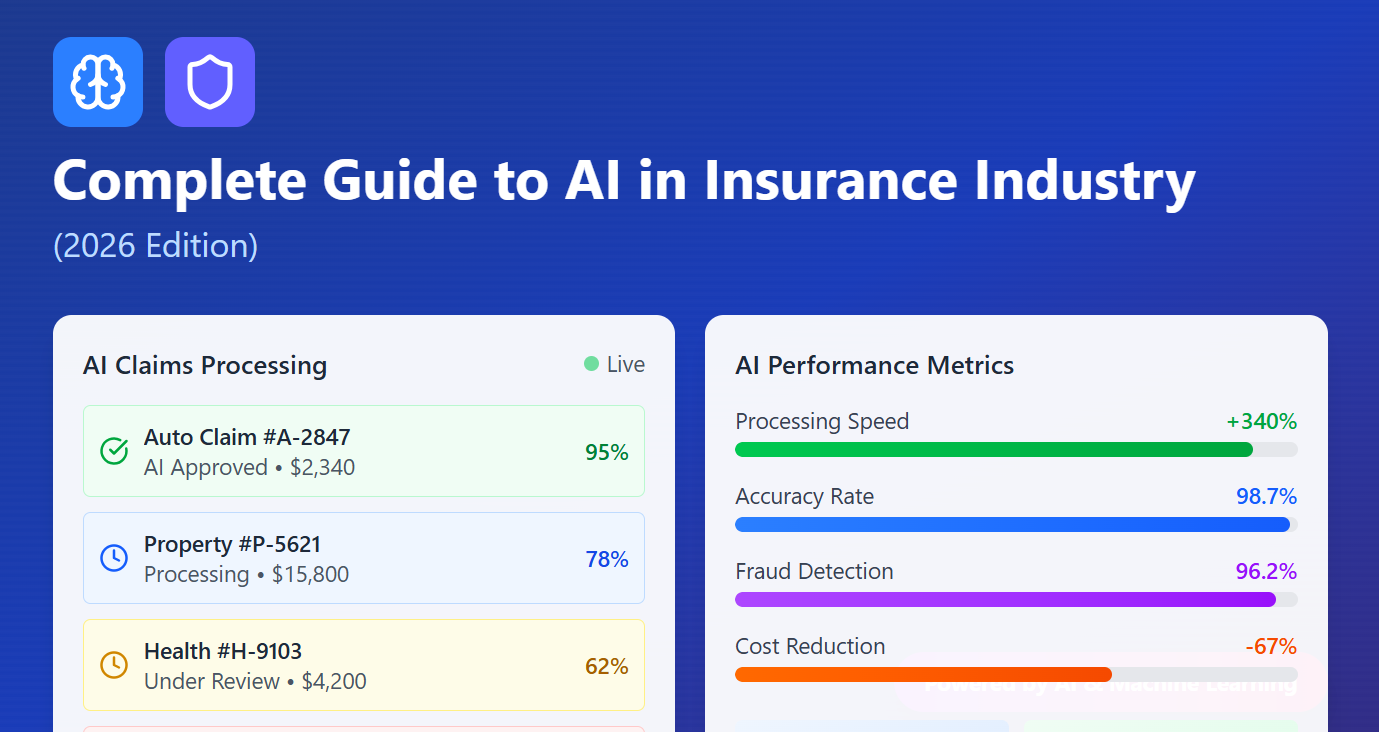
Complete Guide to AI in Insurance Industry (2026 Edition)
The insurance sector is undergoing a structural transformation driven by artificial intelligence. What began as selective automation in underwriting and claims has evolved into a comprehensive shift toward intelligent, data-driven operations. In 2026, AI is no longer a competitive advantage reserved for early adopters. It has become a foundational capability for insurers seeking efficiency, accuracy, and long-term scalability.
This guide offers a detailed perspective on AI in insurance industry explained, covering its core applications, evolving technologies, and strategic implications for insurers operating in a rapidly changing environment.
The Evolution of AI in Insurance
The journey of AI in insurance has moved through distinct phases. Early implementations focused on rule-based automation, primarily targeting repetitive tasks. Over time, machine learning models introduced predictive capabilities, enabling insurers to assess risk and detect fraud with greater precision.
Today, the landscape is defined by advanced systems that integrate real-time analytics, natural language processing, and deep learning. The shift toward intelligent automation has redefined how insurers approach operations, customer engagement, and decision-making.
Understanding AI in insurance industry explained requires recognizing this evolution from static systems to adaptive, learning-driven ecosystems.
Core Applications Transforming Insurance Operations
AI is impacting every major function within insurance organizations. Its value lies in its ability to process vast amounts of data, identify patterns, and make decisions at scale.
Claims Processing and Automation
Claims processing has historically been one of the most resource-intensive functions in insurance. AI is transforming this area through AI for insurance claims automation, enabling insurers to process claims faster and with greater accuracy.
Modern systems can extract data from documents, validate information, and make approval decisions in real time. This reduces manual intervention and accelerates settlement timelines. The integration of AI for insurance claims automation also enhances customer experience by providing transparency and faster resolutions.
Underwriting and Risk Assessment
Underwriting is another area where AI is delivering significant impact. By analyzing historical data, behavioral patterns, and external variables, AI models can assess risk with a level of precision that traditional methods cannot match.
The application of AI in life insurance underwriting allows insurers to evaluate medical records, financial data, and lifestyle factors efficiently. This leads to faster policy approvals and more accurate pricing models. As AI in life insurance underwriting continues to evolve, insurers are moving toward dynamic risk assessment frameworks that adapt in real time.
Fraud Detection and Prevention
Fraud remains a major concern for insurers, affecting both profitability and trust. AI-driven systems use anomaly detection and pattern recognition to identify suspicious activities.
These systems continuously learn from new data, improving their accuracy over time. The integration of AI into fraud detection processes ensures that high-risk claims are flagged without delaying legitimate ones.
The Rise of Generative AI in Insurance
One of the most significant developments in recent years is the emergence of generative AI. Unlike traditional models that analyze data, generative AI can create content, simulate scenarios, and enhance decision-making processes.
The generative AI use cases in insurance are expanding rapidly. Insurers are using these technologies to automate report generation, create personalized customer communications, and simulate risk scenarios.
For example, generative AI can produce detailed claim summaries, reducing the workload for adjusters. It can also assist in drafting policy documents and responding to customer queries with contextual accuracy. As generative AI use cases in insurance mature, they are expected to play a central role in operational efficiency and customer engagement.
Data as the Foundation of AI Success
The effectiveness of AI systems depends on the quality and availability of data. Insurance organizations generate vast amounts of data across policies, claims, and customer interactions. However, this data is often fragmented and unstructured.
To fully realize the potential of AI, insurers must invest in data integration, governance, and standardization. This includes building centralized data platforms and ensuring data accuracy.
A comprehensive understanding of AI in insurance industry explained must emphasize the critical role of data infrastructure. Without it, even the most advanced AI models cannot deliver meaningful outcomes.
Customer Experience and Personalization
Customer expectations have evolved significantly. Policyholders now expect seamless interactions, instant responses, and personalized offerings.
AI enables insurers to meet these expectations by analyzing customer behavior and preferences. Chatbots powered by natural language processing can handle queries, provide updates, and guide customers through the claims process.
Personalization is another key area where AI adds value. By leveraging insights from data, insurers can recommend products that align with individual needs. The integration of generative AI use cases in insurance further enhances personalization by enabling dynamic content creation tailored to each customer.
Integration with Legacy Systems
Despite the advantages of AI, many insurers face challenges in integrating new technologies with existing systems. Legacy infrastructure often lacks the flexibility required for real-time processing and advanced analytics.
Modern AI solutions are designed to address this challenge through modular architectures and API-based integrations. These approaches allow insurers to adopt AI incrementally without disrupting existing operations.
The ability to integrate AI seamlessly is a critical factor in the successful implementation of AI for insurance claims automation and other advanced capabilities.
Regulatory and Ethical Considerations
Insurance is a highly regulated industry, and the adoption of AI introduces new compliance requirements. Insurers must ensure that AI-driven decisions are transparent, fair, and auditable.
Bias in AI models is a significant concern, particularly in underwriting and pricing. Organizations must implement rigorous testing and validation processes to mitigate these risks.
A well-rounded perspective on AI in insurance industry explained includes a strong focus on ethical considerations and regulatory compliance. These factors are essential for maintaining trust and credibility.
The Role of Strategic Technology Partners
Implementing AI at scale requires specialized expertise and a deep understanding of insurance workflows. Many insurers collaborate with an experienced AI software development company to design and deploy tailored solutions.
These partnerships enable insurers to accelerate implementation, reduce risk, and ensure alignment with business objectives. The right partner can provide not only technical expertise but also strategic guidance on how to maximize the value of AI investments.
Future Trends Shaping the Industry
Looking ahead, several trends are expected to shape the future of AI in insurance. These include the rise of autonomous systems, increased adoption of generative AI, and the integration of AI with Internet of Things devices.
The continued evolution of generative AI use cases in insurance will drive innovation in areas such as customer engagement and risk modeling. At the same time, advancements in AI in life insurance underwriting will enable more accurate and dynamic risk assessments.
The broader transformation of the AI in insurance industry will depend on how effectively insurers adapt to these trends and integrate them into their operations.
Conclusion
AI is redefining the insurance landscape, transforming traditional processes into intelligent, data-driven systems. From claims processing and underwriting to customer engagement and fraud detection, its impact is both comprehensive and profound.
This guide to AI in insurance industry explained highlights the critical role of technology, data, and strategy in driving this transformation. By leveraging AI for insurance claims automation, expanding generative AI use cases in insurance, and advancing AI in life insurance underwriting, insurers can achieve greater efficiency, accuracy, and customer satisfaction.
As the industry moves forward, the ability to adopt and scale AI effectively will determine which organizations lead and which struggle to keep pace. The future of insurance is not just digital. It is intelligent, adaptive, and driven by AI.