
Benefits of Using Teacher Scheduling Software in Higher Education Institutions
Higher education institutions are operating in an environment defined by complexity, scale, and constant change. Universities and colleges must coordinate faculty across departments, manage hybrid learning models, and align course delivery with evolving student demand. Within this context, scheduling is no longer an administrative routine. It has become a critical operational function that directly influences institutional efficiency.
Manual scheduling methods are increasingly unable to support this complexity. Spreadsheets and fragmented tools introduce delays, conflicts, and inefficiencies that ripple across the academic system. These challenges impact faculty productivity, student experience, and administrative workload.
This is where teacher scheduling software becomes essential. It introduces automation, structure, and intelligence into academic planning, enabling institutions to manage complexity with precision and scalability.
What Is Teacher Scheduling Software in Higher Education?
Teacher scheduling software is a digital solution designed to automate the allocation of faculty, classrooms, and course schedules within higher education institutions. It uses predefined rules, constraints, and intelligent algorithms to ensure that scheduling decisions are efficient and compliant with institutional policies.
Unlike manual systems, teacher scheduling software integrates with core academic platforms such as Learning Management Systems, Student Information Systems, and enterprise resource planning systems. This integration enables institutions to manage scheduling as part of a unified academic ecosystem rather than an isolated function.
Why Traditional Scheduling Methods Fail at Scale
As institutions expand, scheduling becomes exponentially more complex. Multiple variables must be aligned simultaneously, including faculty availability, course requirements, classroom capacity, and institutional regulations.
Manual processes struggle to handle these variables effectively. They lack real-time adaptability, rely heavily on administrative intervention, and are prone to errors. Even small changes can require extensive adjustments, creating inefficiencies across departments.
Hybrid learning environments further increase this complexity. Institutions must now manage both physical and virtual resources, which adds additional layers of coordination.
Without automation, scheduling becomes a bottleneck that limits institutional agility.
Core Benefits of Using Teacher Scheduling Software
Eliminates Timetable Conflicts and Reduces Errors
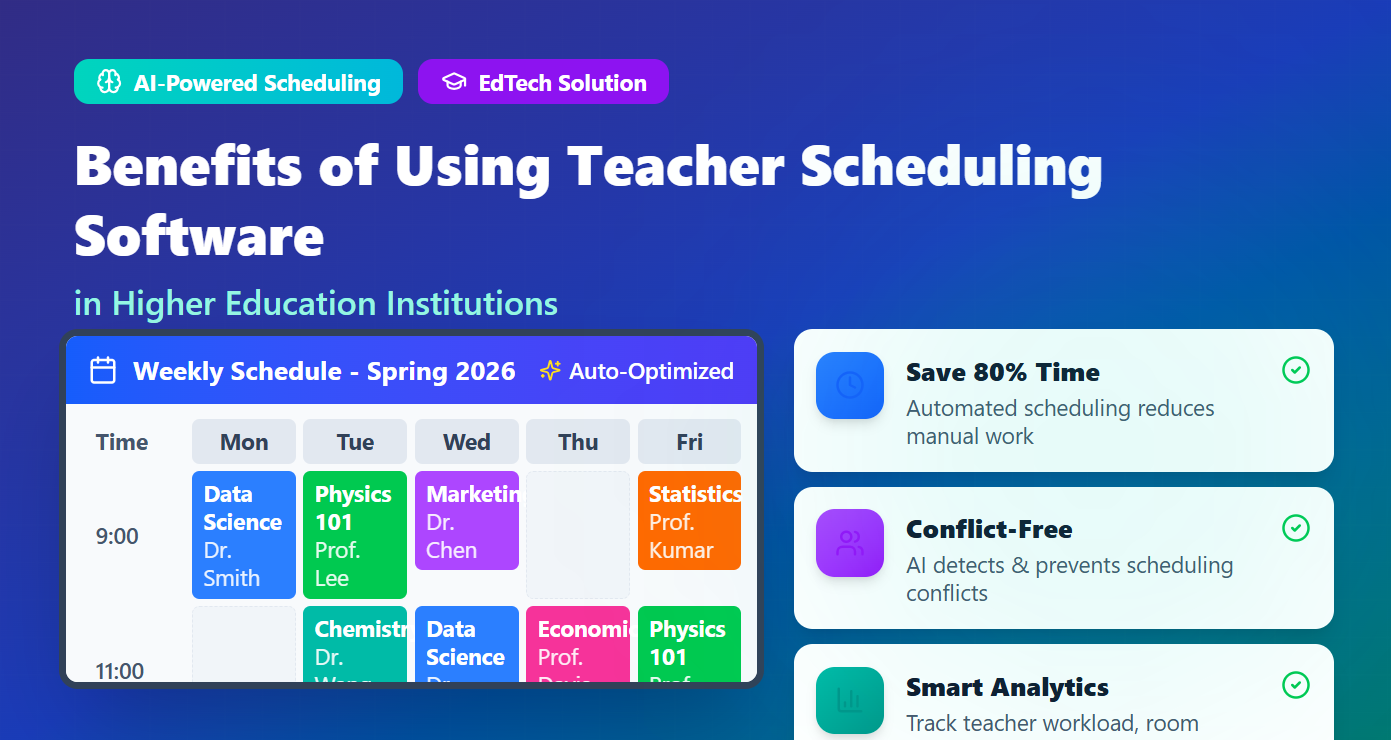
One of the most immediate advantages of teacher scheduling software is its ability to eliminate scheduling conflicts. The system automatically checks for overlaps, resource constraints, and policy violations before finalizing schedules.
This ensures accuracy and reduces the need for manual corrections. Over time, institutions experience fewer disruptions and more reliable academic operations.
Optimizes Faculty Workload and Utilization
Balanced workload distribution is essential for maintaining teaching quality. Uneven allocation of courses can lead to burnout among some faculty members while others remain underutilized.
Teacher scheduling software provides visibility into faculty availability, expertise, and workload capacity. This allows institutions to assign courses strategically and ensure that resources are used efficiently.
Enhances Administrative Efficiency Across Departments
Administrative teams often spend significant time coordinating schedules across departments. This process involves multiple revisions, approvals, and communication loops.
With teacher scheduling software, scheduling becomes centralized and automated. Timetables can be generated quickly, and updates can be implemented without disrupting the entire system.
This improves efficiency and allows administrative teams to focus on strategic initiatives.
Ensures Continuity with Real-Time Adjustments
Academic environments are dynamic, and changes are inevitable. Faculty absences, course adjustments, and resource constraints require immediate action.
This is where substitute teacher scheduling software capabilities become critical. Institutions can quickly identify available faculty, reassign classes, and maintain continuity without disrupting the academic flow.
Real-time adaptability ensures that both faculty and students experience minimal disruption.
Improves Student Learning Experience
Students benefit significantly from consistent and reliable schedules. Frequent changes and conflicts can disrupt learning and reduce engagement.
Teacher scheduling software ensures that schedules are structured and predictable. This allows students to plan their academic activities effectively and maintain focus on learning outcomes.
Enables Data-Driven Academic Planning
Modern institutions rely on data to make informed decisions. Scheduling systems generate insights into faculty utilization, course demand, and resource allocation.
These insights help institutions optimize academic planning, forecast future needs, and improve operational efficiency. Data-driven scheduling supports long-term growth and adaptability.
Strengthens Integration Across Academic Systems
Scheduling is closely connected to other academic functions. Effective systems integrate seamlessly with platforms such as LMS, SIS, and ERP systems.
This integration is a key component of edtech software development, where interoperability ensures that all systems work together efficiently. A connected ecosystem improves data accuracy and operational consistency.
Scales with Institutional Growth
As institutions grow, scheduling requirements become more complex. Increased enrollment, new programs, and additional campuses all contribute to this complexity.
Teacher scheduling software is designed to scale with these demands. Cloud-based infrastructure ensures that the system can handle large volumes of data and users without compromising performance.
How AI Is Transforming Academic Scheduling
Artificial intelligence is redefining how scheduling systems operate. Traditional rule-based systems are evolving into intelligent platforms that can learn and adapt.
An experienced AI software development company can build systems that analyze historical data, predict scheduling needs, and optimize resource allocation. These systems reduce manual effort and improve accuracy over time.
AI-driven scheduling enables institutions to move from reactive planning to proactive decision-making.
Role of AI Integration in Scheduling Ecosystems
The effectiveness of modern scheduling systems depends on how well they integrate with other technologies. AI integration services enable systems to connect, share data, and operate as part of a unified ecosystem.
This integration supports advanced capabilities such as predictive analytics, automated decision-making, and continuous optimization. It ensures that scheduling aligns with broader institutional goals.
Customization for Institutional Requirements
Each institution has unique operational needs. Academic structures, policies, and workflows vary significantly.
With custom AI solutions for enterprise, institutions can tailor scheduling systems to their specific requirements. This includes configuring rules, workflows, and interfaces that align with institutional objectives.
Customization ensures that technology supports institutional strategy rather than imposing limitations.
Strategic Planning Before Implementation
Implementing scheduling software requires careful planning. It is not just a technical upgrade but a transformation of academic operations.
Through AI strategy consulting services, institutions can define clear objectives, identify potential challenges, and develop a structured implementation roadmap. This approach ensures long-term success and minimizes risk.
Key Features to Look for in Teacher Scheduling Software
When selecting a solution, institutions should prioritize features that support both efficiency and scalability.
Key features include automated timetable generation, conflict detection, role-based access control, real-time updates, analytics dashboards, and cloud-based deployment.
These features collectively define a system capable of handling modern academic complexity.
Challenges to Consider Before Implementation
Despite its benefits, implementing scheduling software presents certain challenges. Integration with legacy systems can be complex, and institutions must ensure that data migration is accurate.
Change management is another critical factor. Faculty and administrative staff must be trained to use the system effectively.
Addressing these challenges proactively ensures smoother adoption and better outcomes.
Future of Scheduling in Higher Education
The future of academic scheduling lies in intelligent and adaptive systems. AI-driven platforms will continue to evolve, offering greater accuracy and automation.
Institutions will increasingly rely on systems that can adjust schedules dynamically, analyze real-time data, and support personalized learning pathways.
These advancements will redefine scheduling as a strategic component of academic operations.
Conclusion: From Administrative Process to Strategic Advantage
Scheduling is no longer a background function. It is a critical component of institutional efficiency and academic success.
By adopting teacher scheduling software, institutions gain the ability to manage complexity, improve resource utilization, and enhance the learning experience.
In an increasingly competitive academic landscape, institutions that invest in intelligent scheduling systems will be better positioned to scale, adapt, and lead.
FAQs
What is teacher scheduling software used for in higher education?
It is used to automate scheduling, allocate faculty efficiently, and reduce conflicts across academic departments.
How does teacher scheduling software improve efficiency?
It eliminates manual processes, automates timetable creation, and enables real-time updates.
Can teacher scheduling software manage faculty absences?
Yes, it can reassign schedules quickly and maintain continuity using substitute management features.
Is teacher scheduling software scalable for large institutions?
Yes, cloud-based systems are designed to support complex, multi-campus operations.